

Updates for one year, unlimited sites, auto updates, and regular updates.
$3.99
 BookmarkBookmarked
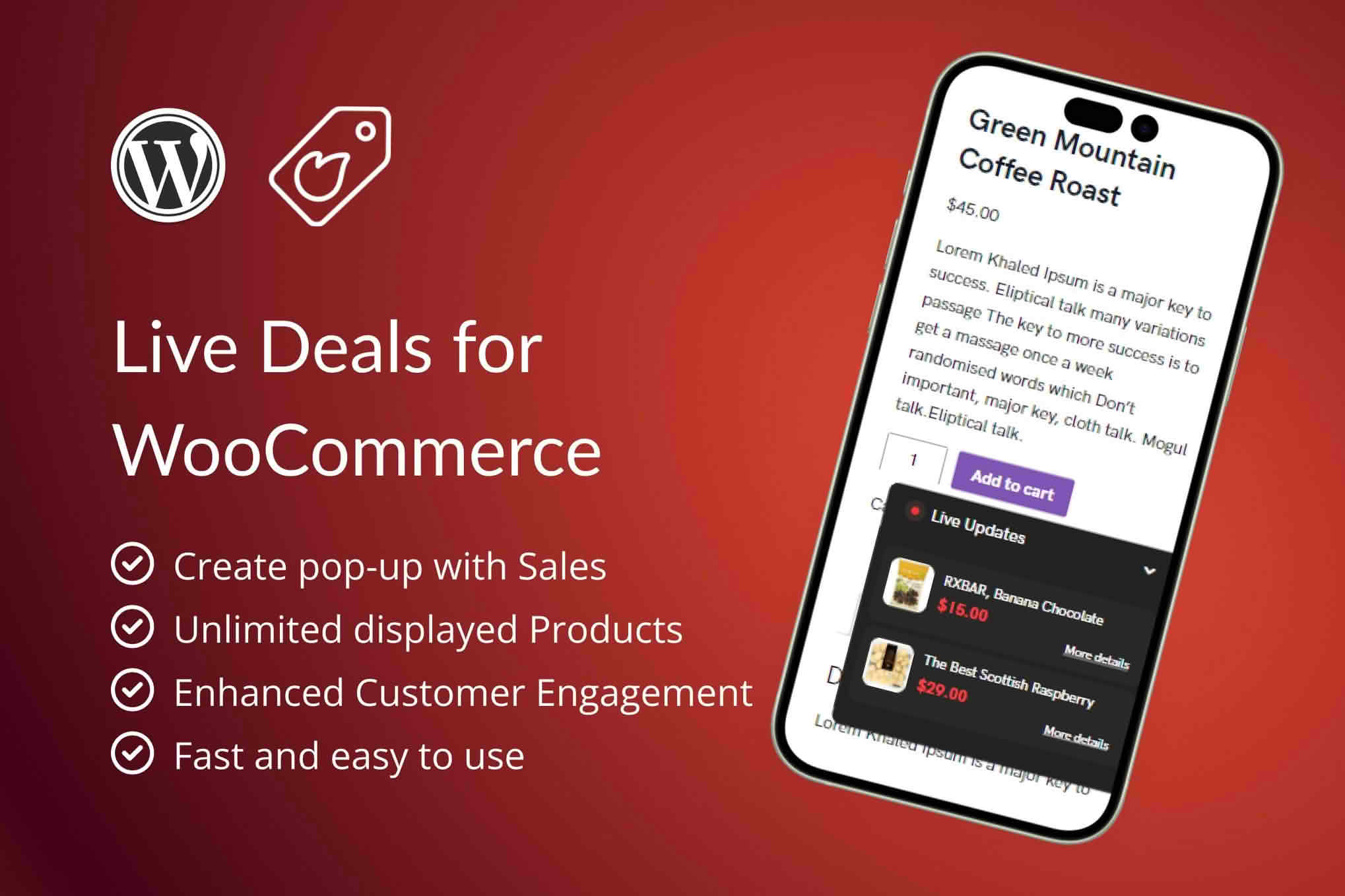
Live Deals for WooCommerce is a plugin whose title points to deals presented on a WooCommerce store. It is intended for store owners who run time-bound promotions and want those promotions to be visible while shoppers browse the catalogue. This entry describes the product’s purpose and general use; it does not list specific features. The notes below therefore explain how deal campaigns are usually planned, presented and reviewed on a WooCommerce site.
Store owners who run seasonal events, weekend promotions, launch campaigns or end-of-season events are the most natural audience for a deals tool. Smaller shops may use time-bound offers to move stock or to reward regular customers, while larger stores may run several overlapping campaigns across different product lines. In each case the central need is a dependable way to show an offer during the period it is meant to be active.
Agencies and freelancers who manage stores for clients can also benefit from a consistent approach to campaigns. A shared calendar, a common testing routine and a standard set of messages make it easier to run similar events across several sites without repeating the same mistakes.
A deals calendar keeps campaigns organised across the year. For each campaign, record its purpose, the products or categories involved, the start and end times, and the people responsible for setting it up and checking it. A calendar also shows where campaigns overlap, which matters when two events could affect the same products. Reviewing the calendar at the start of each month helps identify gaps and prevents too many events from clashing.
Planning ahead also leaves time for design work, copywriting and stock checks. A campaign that is announced at the last minute often leaves little room to correct mistakes, whereas one that is prepared in advance can be tested calmly. Many stores set a deadline for final approval a few days before each campaign begins.
Not every product suits a time-bound campaign. Items with a steady sales history can attract attention without much extra effort, while slower-moving products may need a clearer message or a better position on the page. Consider how each item fits the wider range before deciding which products to include, and avoid building a campaign around items that are close to being withdrawn unless that is the deliberate goal.
Stock levels deserve particular attention. A campaign that draws a crowd can sell out within hours, and shoppers who arrive to find nothing left tend to be disappointed. Confirm that enough units are available for the expected demand, and agree in advance what happens when stock runs low. Review the economics of each item before starting a campaign, so that a time-bound offer does not create an unintended loss.
Campaigns with fixed start and end times need careful handling when a store serves customers in several regions. Decide which time zone governs each campaign, and state that choice clearly in any wording shown to shoppers. A campaign that begins at midnight in one country will begin at a different hour elsewhere, so it helps to say which clock is being used.
Test the boundaries as well. A campaign that ends a few minutes early or late can generate complaints, so check the exact moment a campaign starts and stops. Consider how the store handles orders placed just before the end time, including orders still in the cart or at checkout when the window closes. Writing a short policy for these cases avoids disputes later.
Messages that tell shoppers an offer is ending soon can be effective when they are accurate. They should state the end time plainly, avoid vague phrases, and stay consistent across product pages, category pages, the cart and any email or social post. Messages that exaggerate urgency, or that continue to appear after a campaign has finished, can erode trust. A shopper who feels misled once may not return.
Where a store shows a countdown, the timer should be easy to read at a glance and should not rely on colour alone to convey its status. It should avoid distracting movement, and the surrounding product information should remain clear while the timer updates. Designers should consider people who use screen readers or who have asked their device to reduce motion, and make sure the essential facts remain available without the animation.
Test every campaign in a test environment before publication. Check that the right products are included, that the campaign appears on the intended pages, and that it ends at the planned time. Try the journey as a guest and as a logged-in customer, on a phone and on a desktop computer, and in the most common browsers. Keep a short test script so the same checks can be repeated after an update to WordPress, WooCommerce or any extension.
It is also worth testing the less obvious paths, such as a variable product whose variations carry different stock levels, or a shopper who adds an item to the cart before the campaign opens. Each of these cases can reveal a gap that a simple check would miss.
Campaigns bring attention, and attention brings orders. Make sure the warehouse or supplier team knows when a campaign begins, that delivery timelines are realistic for the expected volume, and that customer service has the information needed to answer questions. Communicate any limits clearly, such as a maximum number of units per customer, so that shoppers understand the terms before they reach the checkout.
Customers appreciate knowing when an offer starts and when it ends. A short email or social post before a major campaign helps, provided the wording stays factual. After the campaign, explain any changes, such as an item that sold out early, and make it easy to contact support. Clear communication reduces refund requests and protects the store’s reputation.
Measure each campaign against its original purpose. Useful measures include visits to the campaign pages, the number of orders placed during the window, the average order size, and any change in returns or support contacts. Compare the results with a normal period so that seasonal effects are taken into account. Record what worked and what did not, and use those notes when planning the next event. Where possible, compare the campaign’s results with the same period in the previous year, since some seasonal patterns recur reliably.
Deals tools touch product data, cart behaviour and checkout pages, so updates to WordPress, WooCommerce or the plugin should be tested before they reach the live store. A backup taken before each update gives a clear route back if something fails, and retesting the main shopper routes after an update catches problems early. Remove finished campaigns so that old offers do not remain visible by accident.
A large share of traffic on many stores comes from phones, so deal messages must stay legible on small screens. Place the most important information near the top of each product page, keep labels short, and avoid layouts that push the add-to-cart button well below the first screen. Test how banners and badges wrap on narrow screens, because a message that fits neatly on a laptop can break across several awkward lines on a phone.
Deals often depend on supplier agreements, shared stock or partner promotions. Confirm in writing what a supplier will provide, when delivery will happen and who approves changes to a campaign. A short briefing before each campaign, with a named contact for urgent issues, reduces the chance of a deal running with no stock behind it.
Anyone who can start or stop a campaign should understand the store’s rules for timing, eligibility and communication. A short written guide, reviewed after each campaign, helps newer staff avoid mistakes that experienced staff have learned to catch. Shared notes about what went wrong, and why, are often the most useful part of that guide.
Live Deals for WooCommerce is aimed at WooCommerce stores that run time-bound promotions, and this entry describes its purpose and general use. Stores that run timed campaigns benefit most from careful planning, accurate messages, thorough testing and honest communication. Those habits matter more than any single feature, and they apply to every deals tool used on a WooCommerce site.


