

Updates for one year, unlimited sites, auto updates, and regular updates.
$3.99
 BookmarkBookmarked
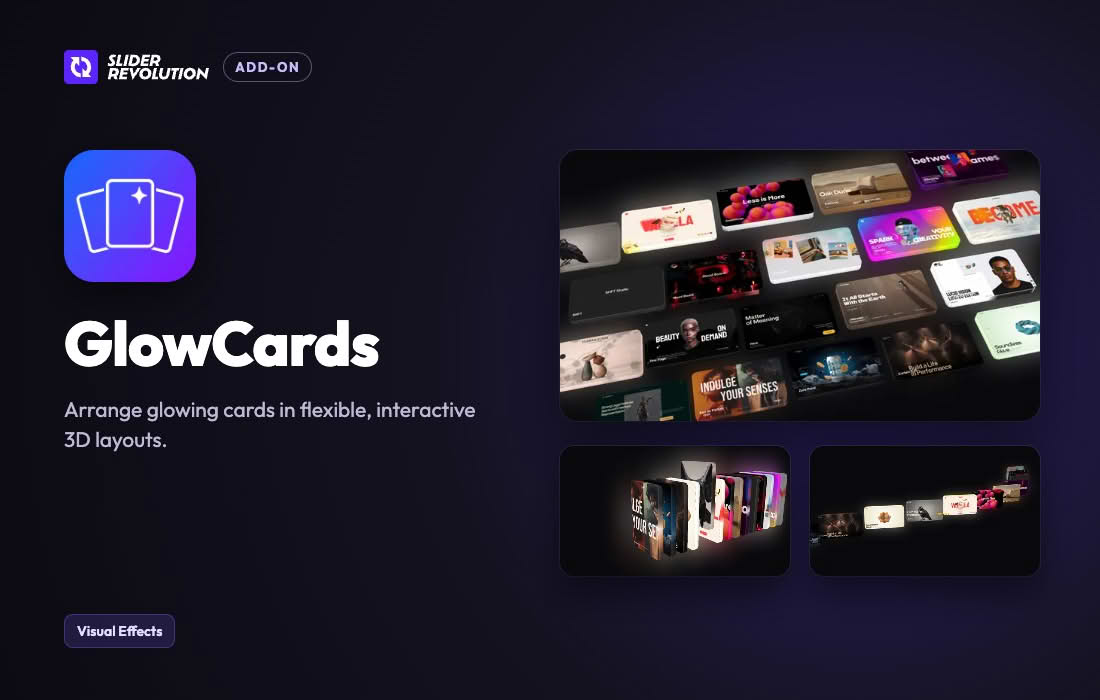
The Slider Revolution GlowCards Addon is an extension for Slider Revolution, the WordPress plugin created by ThemePunch to build sliders and content modules. Addons enhance the plugin’s features, and each addon is installed on a site and then turned on for particular modules. This entry sets out how the addon relates to the wider Slider Revolution workflow, how it is added to a site, how modules are built and tested, and which details should be confirmed before a page is published.
A module is the unit that Slider Revolution places on a page. Inside a module, slides hold the sequence of states, and layers carry the content, whether that is text, images, icons or buttons. Each layer has its own position and timing. Because an addon extends this structure rather than replacing it, one of the most important early decisions is how content should be divided between modules and slides. A well-structured module is easier to adapt when an addon is introduced later.
A module is one part of a longer page, so its spacing should match the sections above and below it. Generous space around a module helps it stand apart, while consistent gaps across the page give visitors a steady rhythm to follow. Avoid stacking several animated modules back to back, because the eye needs a resting point between them. Placing a quieter section after a busy module can also help visitors take in the content that follows.
Content presented as a set of separate items, such as services, features or team members, is often easier to read when each item receives its own consistent area within a module. Before building, sketch the number of items, the order in which they should appear and the information each one needs. Keep titles short, limit body text to a few sentences and use the same structure for every item, so the module feels coherent. These habits make the layout easier to maintain, whichever addon is used alongside it.
Every module should have one dominant element that tells visitors where to look first. Supporting items should be visibly secondary through size, weight or spacing, and they should share a consistent alignment. When too many items compete for attention, the module becomes harder to scan, even if each individual item is well designed. Reviewing the module with the eyes of a first-time visitor usually reveals which element needs to lead.
Short headings and concise descriptions help visitors decide quickly whether an item is relevant. Limit each heading to a few words, keep descriptions to a sentence or two, and use button labels that describe the outcome rather than saying only Read more. Consistent capitalization and punctuation across items make the module look tidy. Clear text also makes translation and future editing easier.
Preparing the addon involves three actions in the plugin dashboard. The first is to open the AddOns area, which presents the catalogue as a dialog. The second is to select the addon and use Install Add-On, which downloads and installs it without any manual file handling. The third is to press Activate Add-On, after which the thumbnail changes from black and white to color to confirm the result.
Activation does not turn the addon on everywhere. Each module that should use it has to be opened in the Module Editor, where the Module General Options tab in the right-hand sidebar contains an Addons entry. Selecting the addon’s icon in that window and pressing Enable Add-On switches it on for that module only. Other modules on the same site are unaffected until they receive the same setting, which gives site owners precise control over where an addon appears.
The visual editor includes more than 200 templates, which serve as starting points for common layouts. A template that depends on an addon indicates that requirement, and building a module from it installs the addon at the same time. Effects from a template can also be copied into a module of your own, so a template can double as a worked example. Starting from a template and removing what is not needed is often quicker than assembling every element from an empty slide.
Module-wide settings, including the module background color found under the layout section, live in Module Options. Slide Options control each slide’s background, while Add Layer offers icons, SVG files and buttons. Size and Position controls provide alignment buttons and numeric fields for precise placement. The Actions panel defines behavior through an action type, an interaction, a target layer and a frame destination. Timing is refined in the timeline editor, the responsive editor reviews the design at different widths, and Preview shows the outcome before publication.
Multi-item content tends to stack awkwardly on narrow screens when the layout has not been checked. Use the responsive editor to review each width, and adjust text size, spacing and order where needed. Avoid placing essential links at the very edge of the module, where thumbs and browser controls may obscure them. Keep the most important item near the top so that it stays visible without extensive scrolling.
Buttons placed in a module can scroll to an element identified by its ID, scroll to the area below the slider or follow a simple link. The right choice depends on whether the visitor should stay on the same page or move elsewhere. Clear labels help visitors anticipate the result, and a consistent pattern across the site keeps navigation predictable.
The addon requires Slider Revolution, which must be active on the site before the addon can be used. Check the plugin version, the WordPress version and any theme or page builder in use, then read the addon documentation for stated requirements. Build and test the module on a staging copy before changing the live site. Record the test results, including the versions tested, so that later updates can be checked against them.
Text placed over images or moving backgrounds can become difficult to read, so each text layer should have enough contrast with whatever sits behind it. Check the module with a color contrast tool, and consider a plain background panel behind any text that must remain legible. Font sizes should stay comfortable on small screens, and line lengths should be short enough for easy scanning.
A preview is more useful when someone other than the builder reviews it. Ask a colleague to check the wording, the order of items and the clarity of the calls to action on a device they did not use to build the module. Collect comments in one place, make the agreed changes in the editor, and retest the affected widths. A short sign-off step before publication reduces the chance of late corrections.
Content in a repeated layout changes, so prepare for additions and removals. Keep the number of items within a range the module can display comfortably, and decide in advance how a new item will be inserted and how an old one will be retired. A simple convention for naming layers and recording their order makes these updates faster and lowers the risk of breaking the layout.
Keep Slider Revolution current and review modules after each update, because layout and timing can change when the plugin or theme is updated. Take a backup before major changes, and keep a copy of any module that is important to the brand. Documenting which addons each module uses saves time when troubleshooting, and it helps a second person pick up the work without guesswork.
The addon is relevant to Slider Revolution users who want to extend what a module can display. Agencies that build sites for several clients will benefit from a shared, documented workflow, while solo site owners may prefer to master the core editor before adding optional extras. Whoever adopts the addon should test it on real devices and keep a record of the settings used.


