

Updates for one year, unlimited sites, auto updates, and regular updates.
$3.99
 BookmarkBookmarked
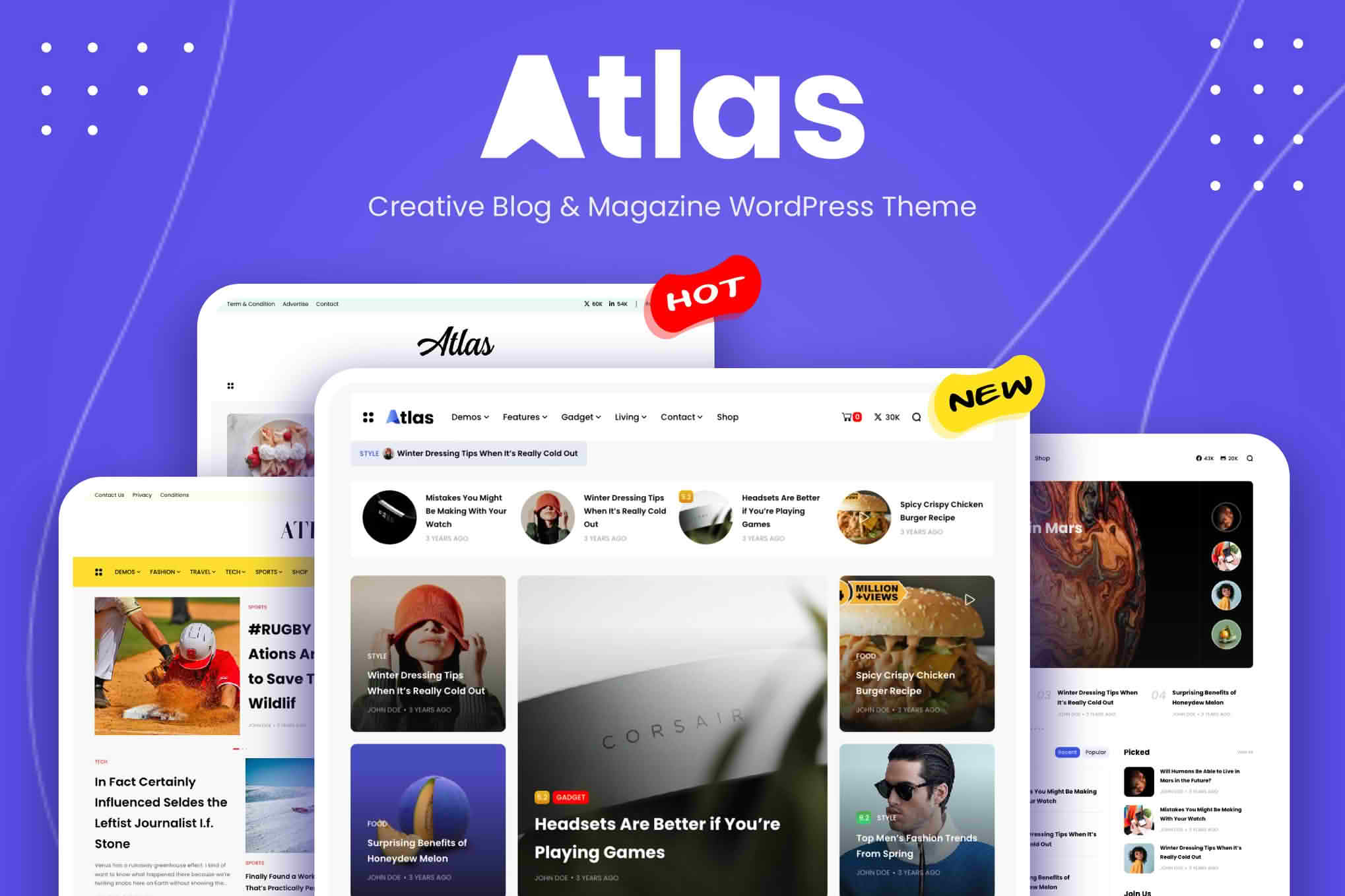
Atlas is a WordPress theme for creative blogs, news sites and content-led publications. It has a compact, modern design, and its sticky navigation, article layouts and reading tools are built to keep readers moving through the content.
Blogs and news sites compete for attention, and readers leave quickly when pages feel slow or cluttered. Atlas presents content in a tidy, well-arranged way so articles are easy to find and easy to read. It fits bloggers, writers, independent journalists and news teams, and its Elementor-based tools let an editor shape the front page without writing code. The theme is meant to be fast as well as attractive, with settings that help pages load quickly.
The design is clean and minimalist, with a tight structure that keeps elements neatly arranged. Five article layouts let a site vary how posts are presented, and grids and masonry blog layouts are among the options. Dark and light skins can be chosen, with custom colors and unlimited color choices, and Google fonts are available throughout.
Layouts are fully responsive and fully right-to-left ready, so a site in Arabic, Hebrew or Persian can display properly. Navigation includes a sticky header and sticky sidebar, megamenus built with Elementor, and an AJAX category megamenu for moving between sections.
A personal blogger can use the reading tools and a clean article layout to build a focused site that keeps attention on the writing. A news site can use the masonry and grid layouts to present many stories at once, with category megamenus helping readers move between sections.
A creative writer or essayist might use the dark skin for a moody, immersive presentation, while a team of reporters can use the light skin for a bright, fast-scanning front page. Social share options and rich snippets help each article travel further once it is published. AMP compatibility adds a lightweight format for mobile readers.
Atlas works with Elementor, Gutenberg and WooCommerce. Contact Form 7 and MailChimp are both compatible, and AMP pages are supported. The theme is translation ready, and because it is fully compatible with WooCommerce, a site can sell products alongside its editorial content when needed.
Gutenberg compatibility means writers who prefer the standard block editor can work in it, while Elementor gives designers more control over the front page. That mix suits a team with a range of technical comfort levels.
Theme options are described as easy to use and lightweight, and they cover colors, skins and layout choices. Combining skins, article layouts and megamenu options lets a publication adjust its look without moving away from the core structure.
Speed optimization settings, lazy loading and a minimal code approach give a site room to stay quick as its archive grows.


