

Updates for one year, unlimited sites, auto updates, and regular updates.
$3.99
 BookmarkBookmarked
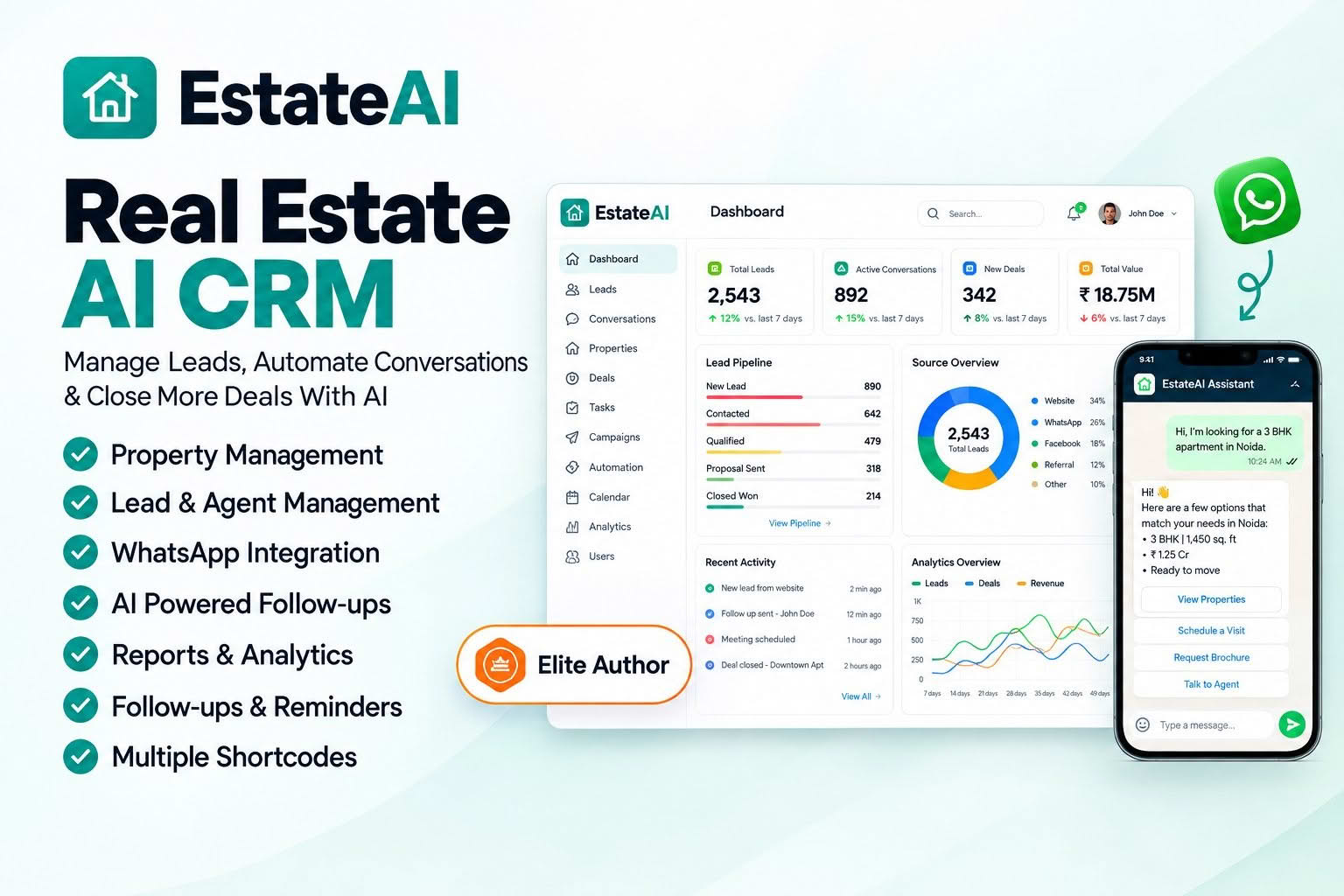
EstateAI is a real estate CRM that sits inside your WordPress dashboard. It brings properties, leads, agents, follow-ups and activities into one place, so the people who run an agency can see what needs attention in a single view. AI assistance is available for drafting listings and organising contacts, which gives routine writing tasks a built-in helper.
Property work is spread across many small tasks: amending a listing, responding to an enquiry, arranging a viewing, chasing a vendor for documents and recording what was discussed. When those tasks live in separate tools, details are easy to lose. Keeping them within the WordPress dashboard means your website, your records and your day-to-day workflow sit side by side.
A single place also makes handovers easier. When a colleague takes over a client, the relevant properties, leads, follow-ups and activities are gathered together, so the new contact does not need to piece the story together from scattered notes, emails and memory.
Many agencies find that the biggest gains come not from any single feature but from consistency. When everyone records information in the same place and in the same way, managers can review progress with confidence, and new team members can get up to speed without relying on one person’s memory.
The dashboard covers five areas of everyday work. Property records describe each listing, lead records describe the people who have shown interest, and agent records show who is responsible for a given property or contact. Follow-ups keep the next step visible, and activities give a running account of what has already happened.
Keeping these areas together makes it easier to see where each relationship stands without checking several separate tools. Good records answer three questions quickly: what was agreed, what happens next, and who is responsible.
The AI help is aimed at two jobs: writing listing descriptions and organising contact information. Both tasks are text-heavy, and both benefit from a consistent voice and a tidy record.
A sensible approach is to treat every AI draft as a first version. Check each figure, feature and claim against the property itself before publishing, and make sure the wording reflects what a viewer will actually find. Accuracy remains the responsibility of the person who approves a listing, whatever tool produced the first draft.
Consistency of tone is another area where assistance helps. A team that describes homes in a similar style across the portfolio gives visitors a more reliable impression, and a shared style guide makes it easier to review drafts quickly.
A lead that goes quiet is often a lead that has been forgotten. Scheduling follow-ups in the same place as the lead they belong to makes it easier to keep conversations moving, and seeing recent activity beside each record helps an agent pick up a thread without rereading an entire history.
Good follow-up depends more on consistency than on speed. Agree on a simple rhythm for contacting prospective clients, record the outcome of every call or meeting, and review open follow-ups regularly so that nothing slips through the gaps.
It also helps to write down what a useful follow-up looks like at each stage of the process. A message after a first enquiry may be very different from one sent after a viewing, and clear expectations keep the whole team aligned.
Before inviting a team to rely on a shared dashboard, agree on the basics. Decide who owns each listing, how leads are passed between colleagues, and what information must be recorded before a task is considered finished. Simple rules applied consistently tend to produce cleaner records than detailed rules that nobody follows.
A short daily review can keep the pipeline healthy. Start the day by checking overdue follow-ups, then scan new enquiries and confirm who will respond. A weekly meeting can look at the bigger picture, including which listings are moving, which need attention and which leads have stalled.
Document the routine on a single page that every team member can reach. New starters will then know what is expected from their first week, and the routine can evolve as the agency grows.
Pipeline reviews work best when they ask a few simple questions. How many new enquiries arrived this week? How many have received a response? Which listings have generated the most interest, and which have had little response? Answers to these questions point to where time should be spent next.
Be cautious about reading too much into small numbers. A single quiet week rarely signals a problem, but a steady decline across several weeks deserves investigation. Comparing one period with another gives a truer picture than any single snapshot.
A listing description should give readers a clear picture of the property without overwhelming them. Lead with the features that matter most to the people likely to view it, describe the layout in plain language, and avoid jargon that obscures the details. Specific, accurate descriptions tend to attract better-qualified enquiries than vague praise.
Consider how photographs, floor plans and text work together. Each one should reinforce the others, so a reader who looks at the pictures and then reads the description finds the same property in both. Mismatches create doubt, and doubt can lose an agency a viewing.
Property marketing is governed by rules that differ from one region to another. Advertising standards, disclosure requirements and equal opportunity rules can all affect how a listing is written, so check what applies wherever you operate.
Photographs, floor plans and descriptions should match the property as it currently stands. Accurate records protect your clients, your reputation and the trust that people place in your listings.
Contact records hold personal information, so it is sensible to limit access to the staff who genuinely need it. Regular backups, strong passwords and clear internal rules about exporting data all help protect the people in your database.
Review your data-protection obligations for each region where you hold contact details. Document how long you keep leads and what happens to their records once they no longer need your service. Those answers should be written down and shared with everyone who uses the system.
Viewings are where interest turns into a decision, so they deserve a clear routine. Confirm each appointment with the prospective client a day in advance, share directions and any access arrangements, and make sure the property is ready before the visitor arrives. Afterwards, record what was said and what the visitor thought, while the details are still fresh.
A quick follow-up within a day or so tends to feel more natural than a message sent a week later. Agree on a standard thank-you note for viewings, personalise the opening line with a detail from the visit, and schedule the next step so that the conversation keeps its momentum.
Notes are only valuable if someone can find and understand them later. Write short, factual entries that include the date, the people involved and the outcome, and avoid private shorthand that a colleague would have to decode. Separate what was observed from what was assumed, so that a future reader can trust the record.
Decide early what belongs in a note and what belongs in a follow-up. A note captures what has happened, while a follow-up sets out what needs to happen next. Keeping that distinction clear makes both easier to search and far less likely to be mixed up.
Property owners want to know how their listing is performing, and a regular summary builds trust. Many agencies share the number of enquiries, the viewings arranged and any feedback received, delivered at a steady interval. Keep the tone factual, and explain what the figures do and do not show, so that owners do not draw conclusions from a single week of quiet activity.
Independent agents, small agencies and teams that handle both sales and rentals can use the dashboard to keep their work in one place. Growing agencies often reach a point where spreadsheets and scattered notes become a bottleneck, and a single dashboard can make that transition calmer.
Whatever the size of your team, EstateAI gives you a single place to manage properties, leads, agents and activities, with AI help for the writing and organising that surrounds them.


