

Updates for one year, unlimited sites, auto updates, and regular updates.
$3.99
 BookmarkBookmarked
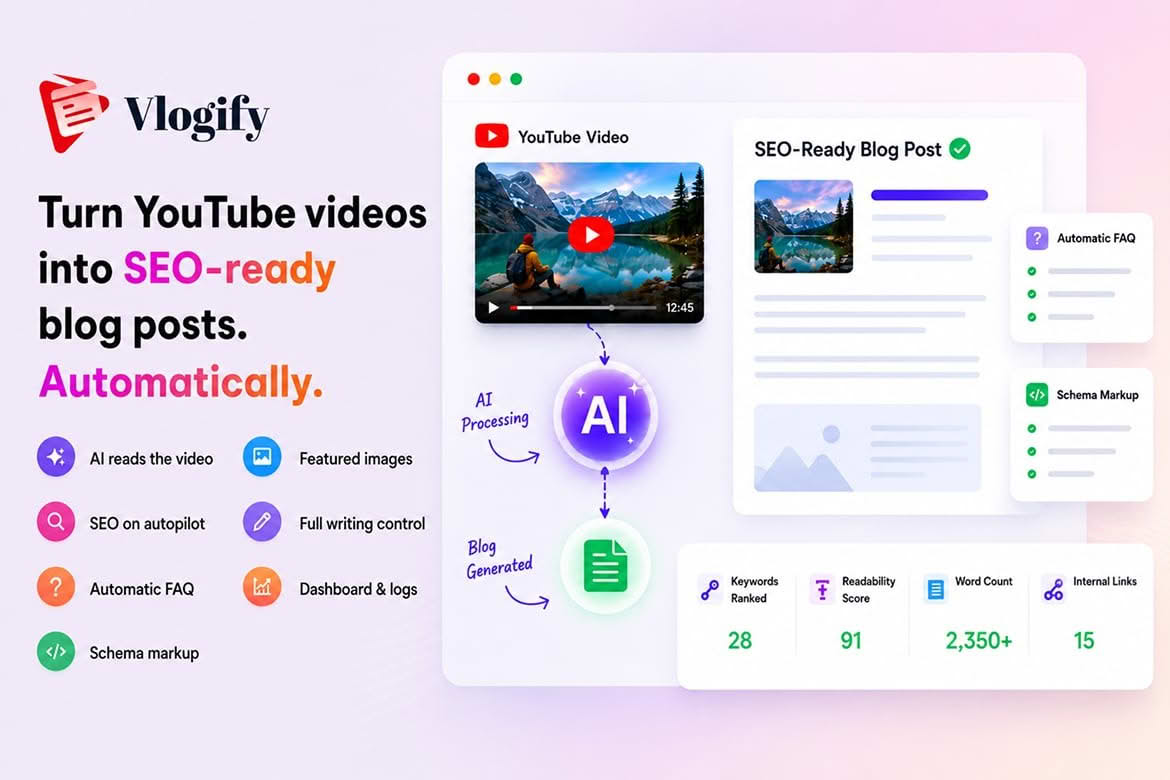
Vlogify is a WordPress plugin whose name describes an AI tool for turning YouTube videos into blog posts. This entry covers the general workflow behind tools in that category, the review steps that matter before anything goes live, and the questions a site owner should settle before using a generator like this on a public blog.
Tools in this category typically start from a video link and produce draft text that an editor can then revise. Many use an AI language model to write the draft, so the result depends on the source material the tool can access and on the instructions it is given. The output is best treated as a starting point rather than as a finished article.
The main value of a tool like this lies in saving time on the first version. An editor still has to choose the angle, verify the claims, and add context that a video alone may not provide. Teams that expect a tool to replace editorial judgment often find that the time saving is smaller than they hoped.
Any AI-written draft should be checked against the source video. Names, dates, figures, product details, and quotations are the items most likely to need correction. A draft that reads smoothly can still misstate a point, so every factual claim should be confirmed by a person before the article goes live.
Original analysis protects the site as well. Readers who arrive from a search engine usually want more than a summary of a video they could have watched themselves. An editor can add comparisons, examples, background, or a clear conclusion that the video does not contain, and that work is what gives the article its own value.
A video’s creator owns the work, and turning a video into a written article raises questions about reuse. Summarizing ideas in one’s own words and crediting the creator is the usual approach. Reproducing a full transcript or large parts of a video’s content generally requires the creator’s permission.
Video platforms also publish terms about how their content may be accessed and reused. Site owners should read those terms before using any tool that works from a platform link. When a commercial use raises specific legal questions, a qualified adviser can give guidance that a general description cannot.
Embedding the original video in an article, with the creator named, is a common way to keep the source visible to readers. A link back to the channel gives the creator recognition for the work and helps readers find more of it.
A written article has its own search requirements, whatever tool produced the first draft. Headings should describe the content clearly, the page should have a meaningful title and summary, and images should carry descriptive alternative text. Internal links to related posts help readers and search engines find the rest of the site.
Near-duplicate content is a risk when an article closely follows a video or another page. Adding original material, as described above, is the most reliable way to give a page its own value, and it also gives the editor a reason to read the draft closely.
Bloggers who already publish video and want written versions of their work for search and archive purposes are a natural audience. Small publishers with limited staff time can also use a first draft as a starting point, provided the editorial review is not skipped.
Teams that run a content calendar across several channels may use a tool like this to keep a written archive in step with video output. A content manager can track which videos have written companions and which still need one.
Writers who cover specialized, technical, legal, or medical subjects may find that a generated draft needs so much rewriting that the time saving is small. In those fields, a qualified expert’s involvement is usually essential regardless of how the first draft was produced.
Readers generally expect to know how an article was made. Some publishers note when a draft was produced with AI assistance and explain what the editorial team checked, which can build trust with readers who are wary of machine-written text. The right level of disclosure depends on the audience, the subject, and the standards the site has already set.
Corrections matter as much as disclosure. When an error is found in a published article, a visible correction note and an updated date show readers that the site takes accuracy seriously.
Video releases and article publication do not need to happen on the same day. Many sites publish the article a few days after the video so that the writer has time for research and a proper review, and some stagger the two so that each one brings traffic to the other. The schedule should be set by the editorial team rather than by the speed of the drafting tool.
Scheduling also helps when several contributors share a site. A shared calendar that shows which video is waiting for its article, and who is reviewing the draft, prevents the same material from being covered twice.
The success of a video-based article is best judged over several weeks rather than on the day it goes live. Useful signals include how long readers stay on the page, whether they follow links to other posts, and whether the article brings in visits that the video alone did not. Editors should compare those signals with the time spent on each draft, because that comparison shows whether the workflow is worth repeating.
The quality of a generated article depends partly on the quality of the video it starts from. Clear speech, a steady topic, and named people or products make it easier to produce a useful draft. Videos with heavy background noise, overlapping voices, or frequent jumps between subjects give a tool less to work with, and the editor will need to do more of the restructuring.
Automatically generated captions are a common source of errors, particularly for names, brands, and technical terms. An editor who relies on captions should listen to the key passages and correct any spellings before publishing. A caption error repeated in a published article looks careless and is easy for readers to spot.
When an article quotes a speaker, the words should match the video exactly, or the passage should be marked clearly as a paraphrase. Quotation marks, a timestamp, and the speaker’s name make the source easy to verify. If a quote is shortened, the editor should make sure its meaning has not changed in the process.
Readers who follow a site expect a consistent voice across its articles. A house style guide that covers sentence length, terminology, and how to refer to the creator helps a team keep generated drafts sounding like the rest of the publication. Editing for voice is often where a draft becomes distinctive, so it is worth giving that step real time.
An article built from a video can go out of date if the creator updates the content or the subject changes. A short note at the top of an affected article, plus a link to any newer video, keeps the archive accurate. Editors who review older posts once or twice a year can catch these changes before readers do.
WordPress.org lists several plugins in this category, including Video To AI Blog Post and Video To Blog. Each has its own feature set, so the features should be compared on the listing pages before any choice is made.


