

Updates for lifetime, unlimited sites, unlimited downloads, and regular updates.
$3.99
 BookmarkBookmarked
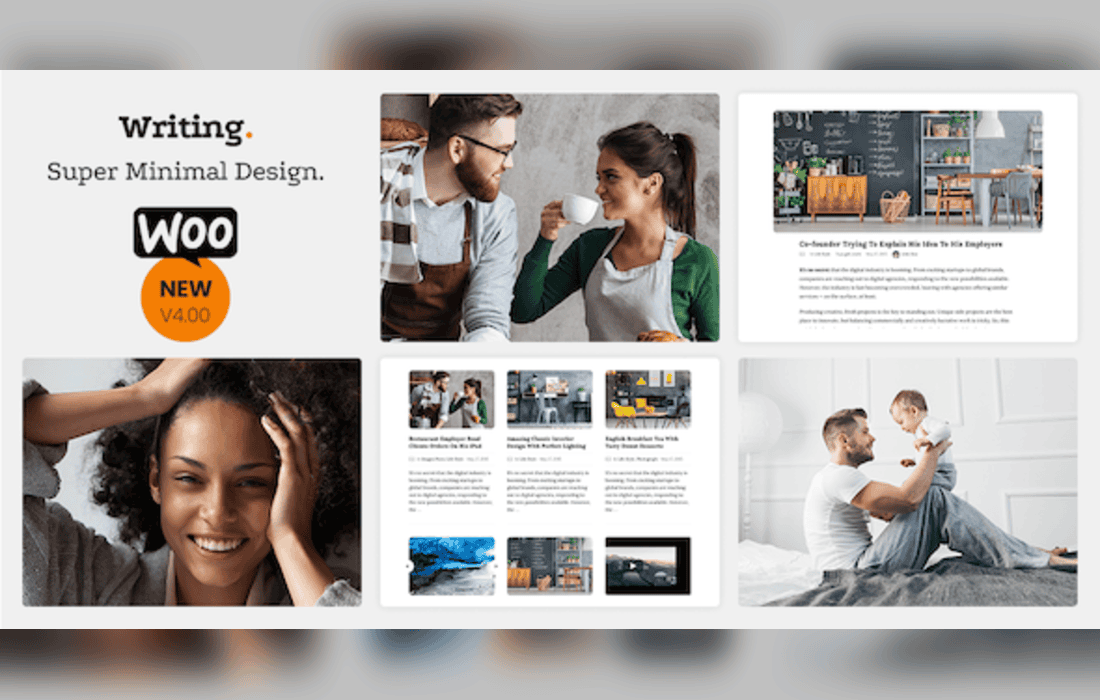
Writing is a clean, minimal personal blog theme for WordPress, built for writers who want readers to focus on the words. It blends modern, classic and minimal styling with careful typography, and it is easy to set up, fully responsive and ready for right-to-left languages.
Writing suits writers, essayists and personal bloggers who publish written work and want the design to stay out of the way. The demo content imports in one step, and once the site is running, fonts, colours and layout options can be adjusted in the WordPress Customizer without touching code.
The reading experience sits at the centre of the design. Content width can be set to wide or narrow, so a long essay can be held to a comfortable line length, and excerpts or full-text listings can be chosen for the blog page. Typography can be tuned for each part of the site, including blog list titles, single post titles, widget titles, meta information, menu items, excerpts and taglines.
Four blog styles are included: classic, list, grid or masonry, and a default layout. The list and masonry styles also have variants that highlight a featured post. Posts per page can be set to suit a blog that publishes often or rarely.
Each article can display a share bar, an author box, related posts selected by category, tag or author, and previous and next links. A reading progress bar helps readers keep their place in longer pieces, and the share bar’s placement can be changed to suit the layout.
A writer who publishes essays, fiction or commentary can choose the classic layout with a narrow content width, which keeps the focus on the text. The grid and masonry styles suit bloggers whose posts depend on photographs, and related posts with previous and next links make it easy for readers to move through the archive.
Bloggers writing in Arabic or other right-to-left languages will find the layout ready for them. Multilingual writers can use WPML to publish the same content in more than one language.
Writing is optimized for the Gutenberg block editor and supports WPML for multilingual sites. It is translation-ready and works with Jetpack Carousel and Tiled Gallery, so galleries and carousels from Jetpack can be used in posts.
Social integration covers Facebook, Instagram and Twitter widgets, an optional Facebook comments feature and social sharing with Open Graph tags. Google Tag Manager and Google Analytics code can be added through dedicated fields. Widgets are supplied by the companion Writing Core plugin.
Colour options cover the site background, the post content background and hover states for the header, top bar and titles, and there is no limit on colour choices. The header background can be set to a single image, a tiled pattern or a cover image, and the logo and menu can be adjusted to suit the site’s identity.
Every setting lives in the WordPress Customizer, so changes can be previewed before they are published. Image sizes and banner loading can be tuned for performance, and the Writing Core plugin provides the widgets that sit alongside the theme’s own options.


